Hydrophobic interactions play a central role in adsorption, molecular recognition, separations, and the behavior of biological and engineered interfaces. Despite this, at molecularly heterogeneous surfaces, hydrophobicity cannot be understood simply from the number or identity of hydrophobic chemical groups.
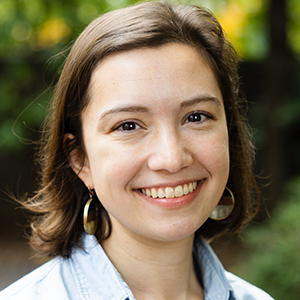
Camille Bilodeau,
University of Virginia
Here, we use molecular dynamics simulations and enhanced sampling methods to investigate how the chemical identity and spatial organization of surface functional groups influence interfacial water behavior, hydrophobicity, and molecular adsorption. We first examine model surfaces containing controlled arrangements of hydrophobic, polar, and charged groups and show that specific chemical group spacings can stabilize or destabilize nearby water molecules. These changes influence the thermodynamics of dewetting and the adsorption of hydrophobic solutes, such that surfaces with similar chemical compositions can exhibit substantially different hydrophobic behavior.
We then extend these principles to more realistic ligand-functionalized interfaces relevant to protein separations and examine how interactions between neighboring ligands alter the exposure and spatial distribution of chemical groups, creating heterogeneous local environments. Using indirect umbrella sampling (INDUS), we quantify the free energy associated with displacing interfacial water and demonstrate the importance of selecting physically meaningful regions for characterizing surface hydrophobicity. In particular, focusing on localized regions involved in protein binding provides hydrophobicity measurements that better reflect experimental protein adsorption trends.
Together, these results demonstrate how hydrophobicity emerges from the interplay between chemical identity, molecular organization, and interfacial water, providing a foundation for understanding and predicting adsorption at complex interfaces and guiding the molecular design of functionalized surfaces.
Dr. Camille Bilodeau is an Assistant Professor of Chemical Engineering at the University of Virginia. Her research integrates statistical thermodynamics, molecular simulations, and artificial intelligence to design new molecules and materials. She completed her Ph.D. at Rensselaer Polytechnic Institute with Shekhar Garde and Steve Cramer, followed by a postdoc at MIT with Klavs Jensen and Regina Barzilay. Dr. Bilodeau is a recipient of the NSF CAREER award and the Institute of Chemical Engineer’s Moulton Medal and is involved in the scientific community through leadership roles in AIChE’s Computational Molecular Science and Engineering and Area 1A, the Biotechnology Division of ACS, and the Gordon Research Conference on Water and Aqueous Solutions.