Catalysts that accelerate chemical reactions will play a central role in enabling new sustainable transformations. Placing metal active sites in the ordered nanopores of aluminosilicate zeolites offers a degree of control over their structures and, moreover, their dynamic evolution during catalysis.
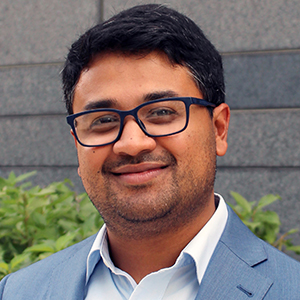
Siddarth Krishna,
University of Wisconsin-Madison
First, I will discuss redox reactions facilitated by zeolite-tethered metal cations, where we combine kinetics and in situ X-ray spectroscopy to reveal the complexities of their reaction mechanisms. In the reduction of greenhouse gas nitrous oxide (N2O) and toxic nitric oxide (NO) by ammonia (NH3) over iron/zeolites for emissions control applications, we reveal the presence of competitive, parallel redox pathways that together dictate reaction rates and selectivities. In the selective oxidation of olefins to carbonyl products by bifunctional palladium-copper systems (replacements for corrosive homogeneous catalysts), we show that catalytic function is governed by competition between multi-site redox pathways and parasitic metal agglomeration pathways, in turn sensitive to both the solvent and redox environment.
Finally, I will discuss the design of supported metal nanoparticles for the reversible (de)hydrogenation of liquid hydrogen carriers, a strategy for long-duration energy storage in chemical bonds. While reactant-induced metal agglomeration is a persistent challenge in liquid-phase reactions, we show that encapsulating metal clusters in zeolite pores protects them from sintering during reaction. Taken together, these insights guide the design of active, selective, stable metal-zeolite catalysts for sustainable chemical transformations.
Siddarth H. Krishna is the Duane H. and Dorothy M. Bluemke Assistant Professor of Chemical and Biological Engineering at the University of Wisconsin-Madison. He obtained his B.S. in Chemical Engineering from UC-Berkeley (2010-2014). He obtained his PhD in Chemical Engineering from UW-Madison (2014-2019) as an NSF Graduate Research Fellow under the supervision of James Dumesic and George Huber. He was then a Henson Postdoctoral Fellow at Purdue (2019-2021) with Rajamani Gounder. Krishna joined UW-Madison as a faculty member in January 2022, where his group combines precise catalyst synthesis, in situ characterization, and reaction kinetics to enable rational catalyst design for sustainable chemical transformations. Krishna is the recipient of an ACS PRF Doctoral New Investigator award (2022), and an award from the NSF DMREF program (2025) leading a collaborative research team studying dynamic catalytic behavior. Krishna has served in leadership roles in the Catalysis Club of Chicago including VP (2023-2024), President (2024-2025), and Director (2025-2027). He also serves on the Early Career Board for Journal of Catalysis.